
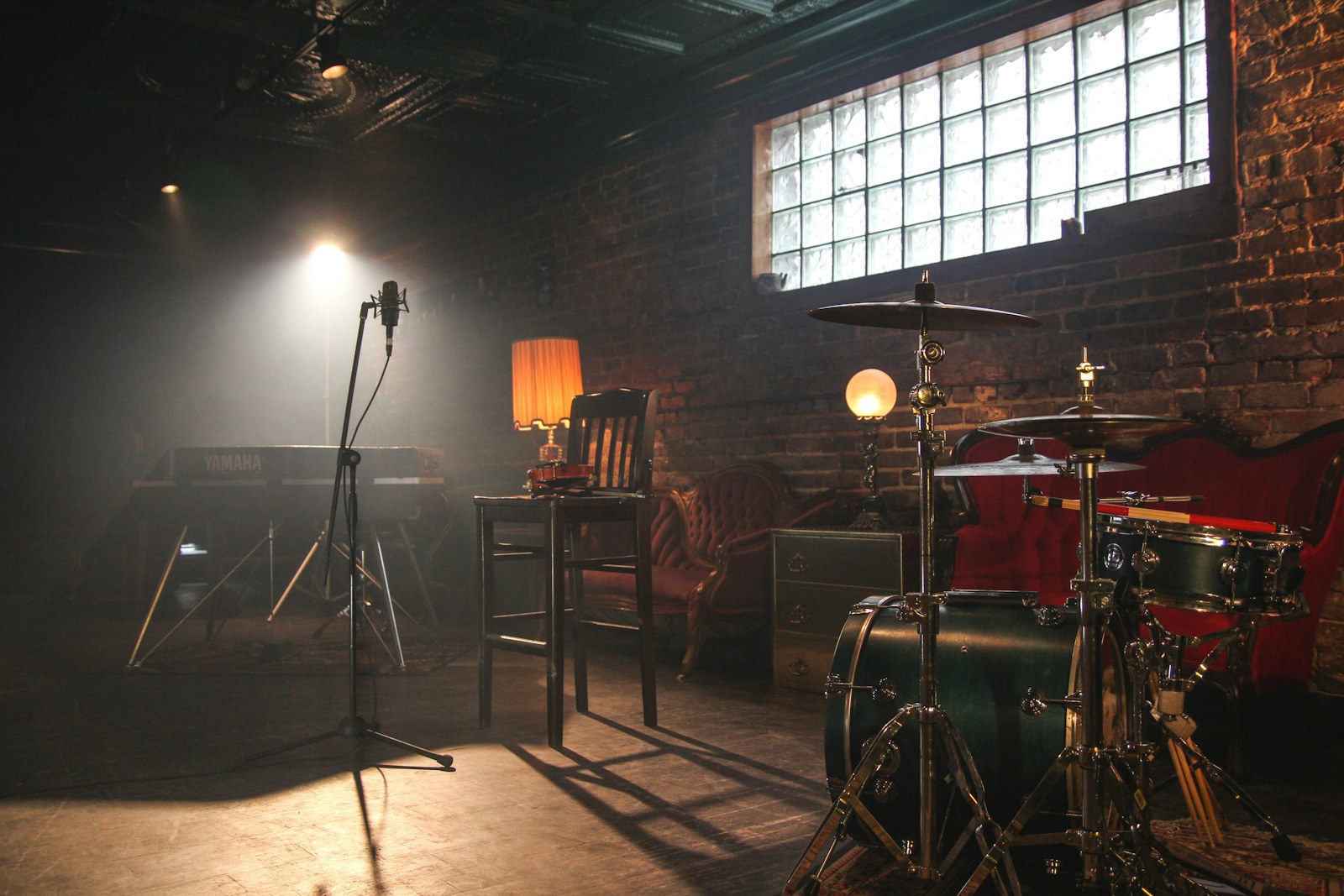
An open mic night gives performers short opportunities to share material in front of an audience, usually within a host’s programme. For a first visit, check the kind of performance accepted, how sign-up works and what equipment is available. “Open” does not necessarily mean every style is accepted or that a performance slot is guaranteed.
This guide helps Devon readers find a suitable event and prepare for a first music performance. It is a practical starting point, not a live calendar or a claim that we have attended the venues mentioned. Sources checked on 5 November 2026.
Featured photograph: John Matychuk on Unsplash. All photographs are atmospheric music illustrations, not images of the open mic events discussed.
Find an open mic night that fits your material
Begin with the town or area you can realistically reach and the kind of performance you want to give. A music open mic, poetry evening, comedy night and instrumental jam can have different expectations. A singer with a backing track may need a different arrangement from an acoustic duo or a full band.
The Open Mic Finder Devon directory is one source of possible leads. Treat directory entries as prompts to contact the venue or host, not as confirmation of the next date. A short list is not a complete record of the county’s events, and “no events found” does not prove that a town has no music activity.
Follow up through the organiser’s current website or published contact route. Confirm the date, year, address, arrival time and audience restrictions. Ask whether visitors can attend simply to listen. Our local live-music discovery guide explains how to build a manageable set of reliable venue and artist sources.
Check the format as carefully as the date
A useful Devon example is Uncut Poets at Exeter Phoenix. Its current page describes poetry, guest readers and open mic places that must be booked. It should not be mistaken for a music slot available to anyone carrying a guitar.
Older pages can also remain searchable. Exeter Phoenix’s separate Open Mic page explicitly describes a past comedy event dated 27 January 2014. A familiar venue name and the words “open mic” are not enough to establish a current opportunity. Read the actual event details before making plans.
Ask the host these questions before travelling
- Is the next event confirmed, and when should performers arrive?
- Do I book a place in advance or join a list on the night?
- How long is the slot, including introductions and changeovers?
- Are covers, original songs, instrumentals and backing tracks accepted?
- What microphones, inputs, stands or instruments are supplied?
- Are there age, access, ticket or other entry conditions?
These are questions, not assumptions about every event. For example, Muncaster’s own music-night page describes signing up on arrival and first-come performance places. That differs from the advance-booking poetry example above. Follow the rules of the actual night you choose.
Keep the host’s response where you can find it. If a message says “arrive early”, ask for the sign-up time rather than guessing. If you need a particular access arrangement, describe it specifically and check the route to the performing area as well as the entrance.
A short message to the organiser
You could write: “Hello, I am interested in attending your next music open mic. I am a beginner singer accompanying myself on acoustic guitar. Could you confirm the date, how to request a slot and whether a vocal microphone and guitar input are available? I can prepare a short set within your time limit. Please also let me know the performer arrival time and any entry conditions. Thank you.” Adapt this to your real setup. A clear enquiry helps the host answer without guessing what you need.
Visit as a listener if the format is unfamiliar
You do not have to perform on the first visit. Watching a night can show you how the host introduces people, how quickly equipment changes and what sort of material fits. It also gives you a chance to notice whether the room feels comfortable for your needs.
Listen without treating the evening as an audition you must pass. Some performers may be experienced and others may be trying something for the first time. The point of your visit is to understand the setting and decide whether it is a useful place for you to take part.
For wider context on local rooms, our historical Devon music venues article offers background. Check each venue’s present programme and facilities independently; an older review cannot confirm a current open mic.

Prepare a short set you can finish comfortably
Choose material that fits the confirmed slot. Rehearse the beginning and ending as well as the middle, and include time for a brief introduction. A set that only fits when you rush every transition is probably too long.
Prepare a shorter version in case the running order changes. That might mean one song rather than two, or dropping a lengthy introduction. Do not assume an audience request overrides the host’s schedule. Ask before extending the set.
Performer Matt Decombe’s open mic advice published by Live Music Research emphasises differences between nights, respect for fellow performers and keeping to the host’s allowance. Use that as a reminder to learn the room rather than expect a universal format.
Rehearse the practical transitions
Practise taking your instrument out, checking tuning and finding the first note without a long explanation. If you use lyrics or chord notes, arrange them so that you can read them without balancing a loose phone on somebody else’s equipment. Ask whether a stand is available.
For a backing track, confirm the accepted format, connection and who operates playback. Bring only the equipment the host has agreed you can use. A file stored somewhere online is not a complete plan if the venue has no reliable connection or the sound operator cannot access it.
Arrive with a clear, simple technical request
Introduce yourself to the host and confirm the name you want announced. Explain your setup in ordinary terms: for example, one vocal microphone and one acoustic guitar connection. Do not move cables, adjust the sound desk or borrow another performer’s instrument without permission.
When it is your turn, follow the host or sound operator’s instructions. Give them a moment to check the setup and tell them clearly if you cannot hear what you need. Avoid turning a brief line check into a full rehearsal.
A small packing check helps: instrument and case, necessary agreed leads, tuner, required power arrangements and any notes. Keep drinks away from equipment. Leave space around the performing area so the next person can set up without navigating a collection of loose bags.
Be a considerate performer and audience member
Listen to other acts, keep conversation away from quiet performances and thank the people running the night. Support can mean attention and encouragement; it does not require buying something you cannot afford. If you have to leave early for transport or another commitment, explain this to the host rather than disappearing when your set ends.
Ask before filming another performer and agree how any recording will be used. If a friend records your own performance, check the venue’s rules and avoid obstructing the audience. A performance opportunity does not automatically grant permission to publish footage of everyone in the room.
Plan for sound levels too. RNID’s earplug guidance is a useful starting point for hearing protection. Do not assume a small room or an informal event must be quiet. Choose an appropriate position and take a quieter break when needed.
Use the first visit to choose one next step
Afterwards, write down one thing that worked and one thing to practise. Perhaps the opening felt settled but the change between songs took too long. Choose a specific improvement rather than judging the entire evening by whether every note was perfect.
If you want feedback, ask a person who has time and make the question precise. “Could you hear the words clearly?” is easier to answer than “Was I good?” Nobody owes a detailed critique in the middle of a running order. Treat new connections as people, not guaranteed routes to bookings.
Frequently asked questions
Do I have to perform?
Usually you can attend as a listener, but check the event’s entry conditions. Watching first can help you understand the format.
Are open mic nights always free?
No. Check audience admission, performer conditions and any booking charges for the particular event. Do not infer the price from the word “open”.
Can I perform a cover song?
Ask the host. Some nights accept covers, some focus on original material and others are not music events at all.
Does signing up guarantee a slot?
Not necessarily. Capacity and booking systems vary. Confirm how places are allocated and be prepared to return another time.
Leave a Reply